

A power outage should not mean losing safe access to your own home. For people with limited mobility, a stairlift aprovides everyday independence, but many homeowners wonder whether it will still operate when the electricity fails. The good news is that most modern models are designed with reliable backup systems that keep the lift moving during a blackout. This article explains how battery-powered stairlifts work, how long they can run without mains electricity, and what you can do to keep the system ready for an emergency.
Understanding Stairlifts and Power Interruptions
For individuals living with limited mobility, neurological conditions, or orthopedic challenges, a residential stairlift is not merely a home improvement. It represents independence, safety, and uninterrupted access to every level of a multi-story home. However, a common concern among homeowners considering this technology is what happens when the electrical grid fails. A sudden blackout can turn a source of independence into a point of vulnerability if the system is not engineered to handle emergencies.
Power outages can occur unexpectedly due to severe weather, grid overload, or localized maintenance issues. During these times, the fear of becoming stranded mid-stairs or confined to a single floor of the house is entirely valid. Fortunately, modern mobility engineering has addressed this vulnerability directly. Contemporary accessibility systems are designed with multi-layered redundancies to ensure that users are never left without a way to navigate their homes safely.
To fully understand how these devices remain operational when the lights go out, it is essential to examine the internal engineering of modern domestic lifts. By understanding the relationship between grid electricity, backup systems, and battery health, users and caregivers can gain complete peace of mind, knowing that their mobility equipment will remain active during critical emergencies.
How Modern Stairlifts Draw Power
In the early days of domestic accessibility technology, many mobility devices operated on direct alternating current from the home electrical outlet. If the main power supply failed, the device stopped immediately. This design presented significant safety risks, particularly if the user was mid-transit when the power failed.
Today, the engineering standard has shifted entirely to protect user safety. Modern units do not run directly on alternating current from the wall outlet. Instead, they operate on a direct current system powered by internal rechargeable batteries. The main wall outlet serves a different purpose: it continuously supplies a low-voltage charge to the internal batteries through a transformer.
This design means the device is always running on stored energy rather than live current from the grid. When the main power goes out, the transformer stops sending electricity to the charging circuit, but the internal energy storage remains fully charged and ready to operate the drive motor. The transition is seamless, requiring no manual intervention from the user.
The Core Solution: Battery-Powered Stairlifts
The primary mechanism that guarantees functionality during a power failure is the integration of heavy-duty, sealed lead-acid or lithium-ion batteries within the chassis of the carriage. A battery-powered stairlift uses these cells to run its motor, providing a smooth and quiet ride regardless of external electrical conditions.
Because the motor draws directly from these onboard batteries, the stairlift can complete numerous trips up and down the staircase even when the rest of the house is in complete darkness. The safety sensors, control armrest, remote controls, and drive motor all remain operational because they are wired directly into this internal low-voltage DC circuit.
These batteries are designed specifically for cyclic use, meaning they can handle being charged and partially discharged repeatedly without losing capacity quickly. They are safely enclosed inside the carriage housing, protected from dust and moisture, requiring minimal direct interaction from the homeowner except during routine professional servicing.
How Charging Stations and Continuous Rail Charging Work
To keep the onboard power cells topped up, manufacturers utilize two primary methods of recharging: point charging and continuous rail charging. Both systems ensure the battery-powered stairlift is ready for an outage, but they function in slightly different ways.
Point charging systems feature designated charge points located at the top and bottom of the rail. When the carriage parks at either end of its track, copper contact strips on the unit touch corresponding metal plates on the rail. This connection allows the low-voltage current from the wall transformer to flow into the batteries. If the user parks the carriage away from these designated points, a warning beep usually sounds to remind them to park it correctly so the batteries do not drain.
Continuous rail charging, often found on premium straight and curved models, features a conductive strip running the entire length of the track. This configuration allows the carriage to draw charging current no matter where it is parked along the staircase. During a power outage, either system will hold its charge, but continuous charging ensures the batteries are always at maximum capacity when the blackout begins, regardless of where the carriage was last parked.
How Long Will a Stairlift Work During a Blackout?
The operational window during a power failure depends on several factors, including the age of the batteries, the weight of the user, the length of the staircase, and the angle of the incline. On average, a healthy set of internal batteries can provide between fifteen and forty full trips up and down the stairs on a single charge.
For most short-term blackouts lasting a few hours or even a couple of days, this capacity is more than sufficient. However, conservation is key during an extended outage. Users should limit unnecessary trips to preserve the stored energy.
It is also worth noting that the battery cells will slowly lose charge over time even when the unit is not in active use. If the power outage lasts for several days, the standby power consumption of the receiver (which listens for remote control commands) will slowly deplete the cells. If a prolonged outage is expected, some manufacturers allow the unit to be switched off via a main power switch to preserve charge, though this should only be done when the unit is safely parked.
Essential Battery Maintenance for Reliability
To ensure that your mobility equipment performs flawlessly during an unexpected emergency, regular maintenance of the power system is necessary. The most important rule is to keep the system plugged into the wall outlet at all times under normal conditions. Some users mistake the wall outlet for a light switch and turn it off when they go on vacation, which can lead to deep discharge and permanently damage the batteries.
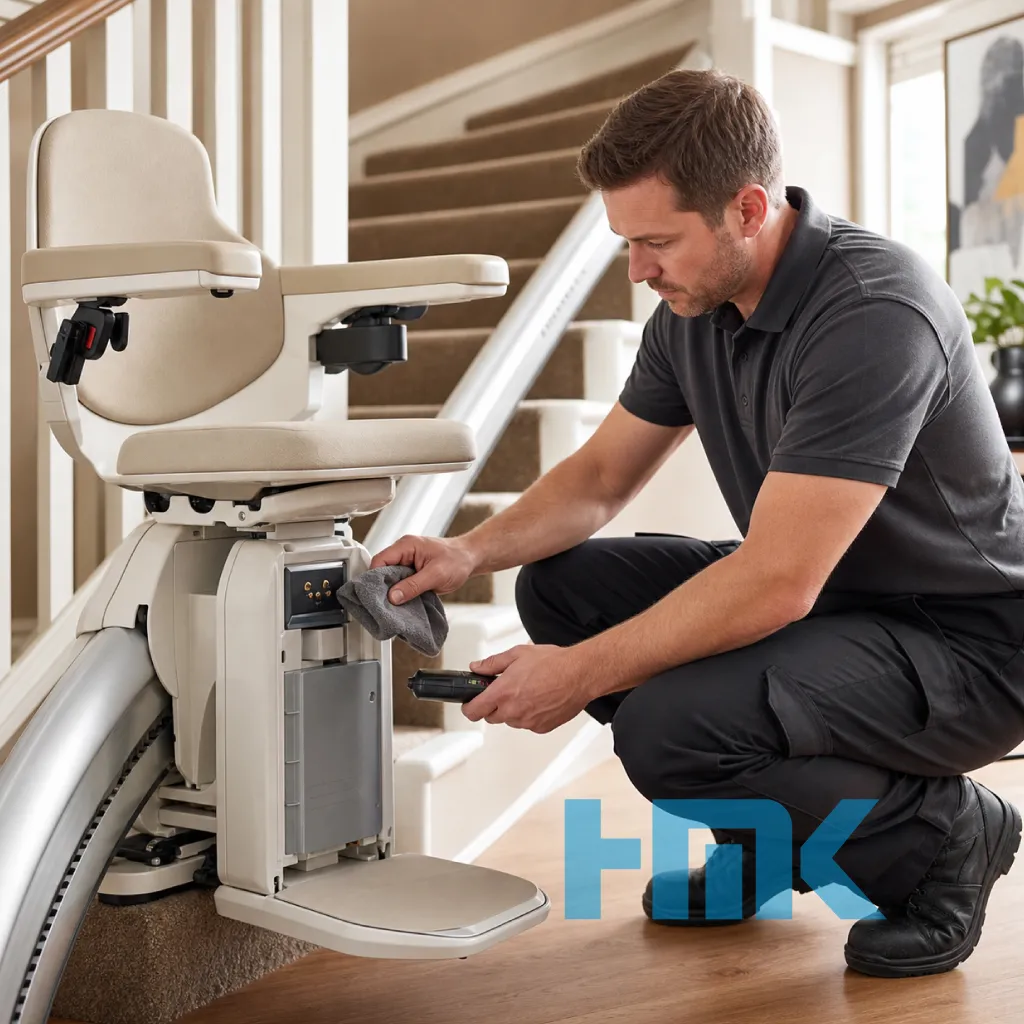
Professional technicians should inspect the charging contacts and battery health during annual maintenance visits. Over time, dust, pet hair, or oxidation can build up on the metal charging strips, preventing the current from flowing efficiently. Cleaning these contacts gently with a dry cloth can help maintain a strong connection.
Typically, the internal batteries last between three and five years before they require replacement. If you notice the carriage moving slower than usual, or if it makes warning sounds when parked at a charging point, it is likely time to schedule a replacement to ensure the system remains reliable when you need it most.
Also Read: Battery powered stairlifts
Conclusion
Stairlifts are engineered with safety as the highest priority, and the inclusion of robust backup battery systems ensures that a power failure does not compromise your mobility or independence. By operating on a continuous low-voltage direct current circuit, these devices decouple themselves from the vulnerability of the municipal power grid. Knowing how your battery-powered stairlift charges, how long it can run during an emergency, and how to maintain its power cells ensures that you can navigate your home confidently, regardless of the weather or electrical disruptions outside.
FAQ
1- Do stairlifts still work when the power goes out?
Yes, modern units run on internal rechargeable batteries that continuously charge when the main power is on. During a blackout, the device switches automatically to battery power, allowing you to use it normally.
2- How many times can I use the stairlift during a power failure?
A healthy battery system generally provides fifteen to forty full trips up and down the staircase, depending on user weight, the length of the track, and battery health.
3- Will the remote control call buttons work during a blackout?
Yes, the wireless wall switches and handheld remote controls run on their own small batteries, and the receiver inside the carriage runs on the main backup battery, meaning all controls remain functional.
4- How do I know if my stairlift is not charging?
Most models will emit an audible beep or display a warning light on the carriage diagnostic panel if the unit is parked away from a charging point or if the wall outlet is turned off.
5- How often do I need to replace the backup batteries?
The internal rechargeable batteries usually last between three and five years, depending on usage patterns and regular maintenance.